Drafting theories comes and go, but I just got reminded of one basic concept of an ideal Limited deck- the BREAD Theory. As I've accumulate some experience since I first read it (when I start to play magic) I'd try to give it another look, and try to suit it to Magic Origins. BREAD is actually an acronym, but not everyone have same perception about them, especially for A and D, so I'd like to share my own view of BREAD theory:
B - Bombs or Brutally-efficient
They are powerful cards that can turn the tide of battle into your favor, even from losing position. They can also be crazy efficient card, giving so many utilities while also being not too costly. Usually, they are found in rares, however there are a lot of uncommon that worth the title as well, as uncommons are found in little number too. They are worth the first pick (if present) and You should looking for those first every pack. Bombs are good signal to know (or let a player next to you know) that a color is open in draft.
R - Removal
Playing Magic, or Hearthstone, is not all about building your board, but also being reactive to your opponent's. Removal is is great to prevent your opponent from playing their powerful creature or to push your own damage. Because of this versatility, their demand are high and sometimes prioritized over very strong creatures. Cards that "lock" creatures such as Claustrophobia are also considered removal as they render a card useless.
E - Evasion
There will be time when you and your opponent cannot profitably attack anymore due to complex board state. This usually happens when most of the creature are non-evasion creatures. Evasion means your card have some way to not be blocked, and thus allowing you to gain edge turn by turn until you win. They are key to win an otherwise unwinnable battle.
A - Aggro
For me, Aggro is efficient creatures that you will use to attack. Attacking is good as it will win you game. Aggro creatures IS capable of either threatening your opponent's life total or trading with your opponent's creature. Trading is okay because not everyone will be willing to trade their creature, in the other hand, if you have good mana curve and healthy number of creatures, you can constantly field threats to threaten your opponent.
D - Defensive, SiDeboard, Deck-Specific, and Duds
I remember the most common interpretation of D is Duds, which is garbage cards you cannot use. While it's true that the four category above (BREA) is what wins you games, Defensive and Sideboard card is intended to further secure your wins. As they are less important than BREA cards, I think it's only worth it to only pick them on last picks of a pack. You should always prioritize BREA cards. Oh, there are also deck-specific cards that is usually not wanted but very useful when you already got another synergistic card to help it. They could be a main part of your strategy, but still you shouldn't early pick them or prioritize them over BREA cards. Duds are still cards that you can't play because you are going to get those from few last picks in a pack.
Alright, that's for my version of BREAD theory. I'm going to use this as a template to categorize the cards next. See ya later!
Tampilkan postingan dengan label Magic: The Gathering. Tampilkan semua postingan
Tampilkan postingan dengan label Magic: The Gathering. Tampilkan semua postingan
Rabu, 26 Agustus 2015

Selasa, 21 April 2015
LTLM's Simplified Quadrant Theory
You know, sometimes we misjudged a card. Sometimes we think that a card is OK when it actually plays bad most of the time.
Quadrant Theory divides the card usefulness depending on situations you might be in:
1.) developing the board
2.) stuck in a stall
3.) trying to finish your foe (having chance to win the game)
4.) under the threat of losing the game
An amazing card will excel at many of the quadrant and worst cards will not excel in any quadrant at all. If you are interested in Quadrant Theory, you can check it out at Magic's website! I might also try to delve into this deeper maybe some other time. For now, this article is only a note of some sort.
Usually, to see whether a card is a good card or not, you can try to imagine how well it does in 4 situation (quadrants):
1.) Do I like to see this card early?
2.) When the game is stuck or worse, do I WANT to draw THIS?
3.) When I need to finish my opponent fast, does this HELP?
4.) When my opponent have the upper hand, does this HELP?
So let's see:

Pristine Skywise! Is this card good?
1.) Do I like to see it or play it early? I probably don't. The same with other high mana cost cards, I'd rather have something playable early and leave this for late draw. As mana is the fewest in the early part of the game, your opponent will have better window in putting down your Skywise.
2.) When the board is stalled, do I want to draw this? Yes! This possibly is the strongest creature in my deck and by having it I will have strong advantage over my opponent! It is also a strong flier, that will be able to start pressuring from the air when the opponent doesn't have a strong front there.
3.) When I need to finish my opponent, does this help? Probably not. Even though this card will definitely ensure your position, but it doesn't help you win right away. Pristine Skywise is not a card that excels at this situation. At extreme situation, you will need a card that really helps in this situation. Imagine someday you are at 4 life and if you don't defeat your opponent right now he'll play Sarkhan's Rage at you, in that situation, no matter how good the card is, you won't win the game.
4.) When my opponent have the upper hand, does this help? Probably yes, depending on the situation. Pristine Skywise is big and can block both flying and land creature, not to mention with a single spell, he can be protected from damage from a color or spell! If the condition is not too dangerous, you can probably stabilize the field by casting Pristine Skywise. Generally, cards that is good at blocking will have good score in this category. It's not a true problem solver, but it sure help!
From those observation we see that Pristine Skywise will be good most of the time when you draw him and is not clogging your early hand. So we can deduce that Pristine Skywise is a good card overall!
Okay, that's it for the simplified Quadrant Theory! Can you see your cards better now? I hope that I didn't forget this myself lol
1.) developing the board
2.) stuck in a stall
3.) trying to finish your foe (having chance to win the game)
4.) under the threat of losing the game
An amazing card will excel at many of the quadrant and worst cards will not excel in any quadrant at all. If you are interested in Quadrant Theory, you can check it out at Magic's website! I might also try to delve into this deeper maybe some other time. For now, this article is only a note of some sort.
Usually, to see whether a card is a good card or not, you can try to imagine how well it does in 4 situation (quadrants):
1.) Do I like to see this card early?
2.) When the game is stuck or worse, do I WANT to draw THIS?
3.) When I need to finish my opponent fast, does this HELP?
4.) When my opponent have the upper hand, does this HELP?
So let's see:
Pristine Skywise! Is this card good?
1.) Do I like to see it or play it early? I probably don't. The same with other high mana cost cards, I'd rather have something playable early and leave this for late draw. As mana is the fewest in the early part of the game, your opponent will have better window in putting down your Skywise.
2.) When the board is stalled, do I want to draw this? Yes! This possibly is the strongest creature in my deck and by having it I will have strong advantage over my opponent! It is also a strong flier, that will be able to start pressuring from the air when the opponent doesn't have a strong front there.
3.) When I need to finish my opponent, does this help? Probably not. Even though this card will definitely ensure your position, but it doesn't help you win right away. Pristine Skywise is not a card that excels at this situation. At extreme situation, you will need a card that really helps in this situation. Imagine someday you are at 4 life and if you don't defeat your opponent right now he'll play Sarkhan's Rage at you, in that situation, no matter how good the card is, you won't win the game.
4.) When my opponent have the upper hand, does this help? Probably yes, depending on the situation. Pristine Skywise is big and can block both flying and land creature, not to mention with a single spell, he can be protected from damage from a color or spell! If the condition is not too dangerous, you can probably stabilize the field by casting Pristine Skywise. Generally, cards that is good at blocking will have good score in this category. It's not a true problem solver, but it sure help!
From those observation we see that Pristine Skywise will be good most of the time when you draw him and is not clogging your early hand. So we can deduce that Pristine Skywise is a good card overall!
Okay, that's it for the simplified Quadrant Theory! Can you see your cards better now? I hope that I didn't forget this myself lol
Jumat, 17 April 2015
DTK Draft: The Roles of Green Commons

I've thinking some different ways to write the guide for now, this time, I'd try to explain the green commons by the roles they would able to fill. I hope this could tell importance of each card even better than to explain them one by one.
Senin, 13 April 2015
DTK Draft: Green Uncommons
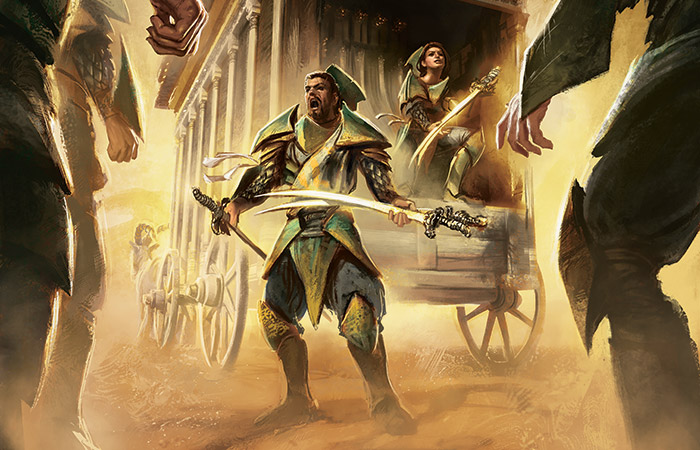
Going Green
Hi there! Today I'll try to touch a bit specific topic in draft: Spotting good green uncommons when you draft DTK-FRF! Okay, a lot of of question I believe. For starters, I'd recommend you to read some basic draft guide from wizards.magic.com or other sources especially about card roles (BREAD) and signals, when you're done lets go on!Why such guide? First, because I believe by recognizing good cards you could easily tell if a color is open (in this case, green). Open color is a color that another player(s) didn't pick, and when you pick an unpicked color, chances are you'll get cool cards passed to you in that color! And as Uncommon usually have better card than common, it could provide an even better insight. Second, why green? because when I see green cards in DTK FRF draft I could hardly judge whether a card is good or not so I hope I can improve my draft ability as well! How about rares? well, you only get three rares at most and you can hardly count them on being green card, but when it does, you can expect it will be powerful enough to guarantee your pick in that pack!
Jumat, 10 April 2015
DTK Drafts: Picking Rares
Hi! I am Indra, a new MTG player from Indonesia. I played a lot of TCGs, mainly Yu-Gi-Oh, but moved on to Hearthstone and eventually Magic because I couldn't cope anymore with the competitive scene as I have graduated and have to focus most of my time on my career.
Although not having everyday to play, I still love TCGs tho. Instead of strangling myself insane mindwork in Competitive/Constructed formats, I pick more casual form of playing in limited environment, thats why I love Hearthstone's arena and Magic draft / sealed so much the time I started it, there are not a ton of cards or rogue strategies to worry about in smaller pool of limited. Okay, lets get to the article!
Although not having everyday to play, I still love TCGs tho. Instead of strangling myself insane mindwork in Competitive/Constructed formats, I pick more casual form of playing in limited environment, thats why I love Hearthstone's arena and Magic draft / sealed so much the time I started it, there are not a ton of cards or rogue strategies to worry about in smaller pool of limited. Okay, lets get to the article!
 |
| This gif will be my charm |

"To Pick, or Not to Pick?"
Today's article is hopefully a simple, but helpful one, and aimed more towards casual player like me. As a casual and also budget player, I seek to gain the most profit from my drafts. Oh, also I don't think of playing constructed at all so I intend to sell all valuable cards I got from my draft, so keep that in mind because that's the point of this article. I also intend this to be a series of some kind, as I'd like to share how to choose good card for your drafts.
Langganan:
Postingan (Atom)